A Day in Albi, the Brick-Built Episcopal City on the Tarn
Albi rewards the 1h15 drive from Carcassonne with the fortress-like brick Sainte-Cécile cathedral, the world's largest Toulouse-Lautrec collection, and Gaillac vineyards on the route home.
- Flag
-

- ISO code
- FR
- Population
- 52,409
- Currency
- EUR
- Timezone
- Europe/Paris
A Day in Albi, the Brick-Built Episcopal City on the Tarn
The Pont Vieux curves low over the Tarn River, its nine arches unchanged since the 11th century. On the far bank, Sainte-Cécile Cathedral rises not in pale stone but in rose-red brick, a fortress-church that looks less like a place of worship than a war machine designed to intimidate. This is the visual argument for leaving Carcassonne behind for a day.
The drive from Carcassonne to Albi takes 1 hour 15 minutes by car. Treat that hour as a deliberate shift between two versions of Languedoc. Carcassonne is Cathar country: limestone, crag-top ruins, the memory of sieges and pyres. Albi belongs to a different medieval logic entirely, one built in brick along the Tarn by bishops who wanted their power visible from every approach. The Episcopal City of Albi earned its UNESCO inscription in 2010 not because it preserves one masterpiece but because the cathedral, the adjacent Palais de la Berbie, and the old bridge form a complete brick-built ensemble that has no equivalent in France. Here is exactly what to see in Albi, where to prioritize your time, and how to break the return drive so the day does not feel like a punishment behind the wheel.

Why Albi Justifies the Drive from Carcassonne
The question is not whether Albi is worth seeing. It is whether it justifies 2.5 hours of round-trip driving when you could stay closer to your base. The answer depends on what you want from Languedoc. If your itinerary is built around Cathar castles, Roman ruins, and coastal seafood, skip Albi. The detour pulls you north of the Tarn into a landscape of vineyards and hilltop villages that belongs to a different historical layer. But if you have any appetite for medieval art, for the peculiarity of a brick cathedral that survived the Wars of Religion and the Revolution intact, the drive earns itself.
The Cathedral Interior And Its Painted Vault
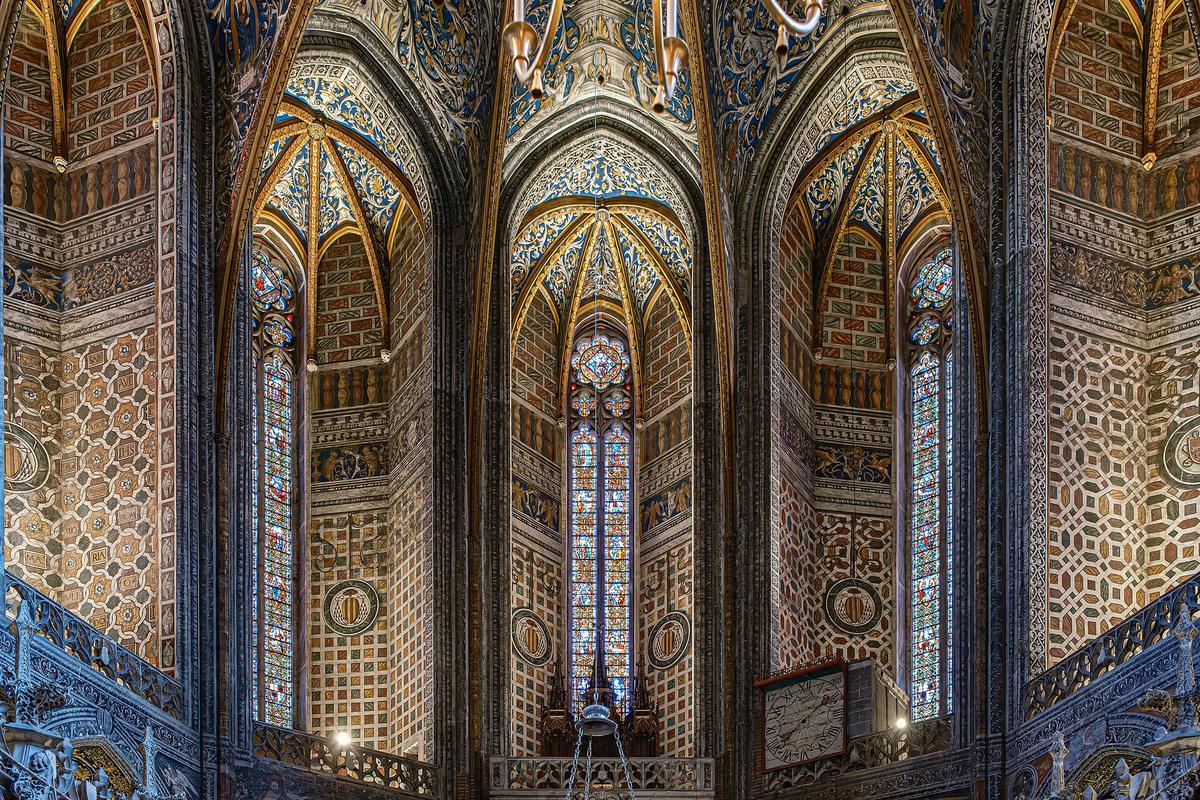
Arrive by 09:30. The cathedral opens at 09:00, and the morning light through its south windows makes the interior tolerable before the summer heat builds. Sainte-Cécile looks fortress-like from the outside for a reason: construction began in 1282 as a statement of authority after the Albigensian Crusade, and it was substantially complete by 1480. The brick exterior was an engineering necessity. The Tarn valley lacked good stone, but it had excellent clay, and the builders knew how to fire bricks that would hold for centuries. What you cannot see from the outside is the interior. Walk through the single west door, let your eyes adjust, and look up.
The ceiling is a single barrel vault, entirely painted: a vast 15th-century fresco cycle depicting the Old and New Testaments. This is the largest surviving cycle of Italianate mural painting in France, and it is the primary reason Albi belongs on your itinerary. The colors are intact. The Last Judgment scene on the west wall shows the damned in chains, and the detail is specific enough that you can identify individual expressions of despair. Stand at the back of the nave and take in the whole vault before you move closer. The effect is disorienting. You are standing inside a book that took two centuries to illustrate.
The Toulouse-Lautrec Museum and the Bishop’s Palace
Step out of the cathedral through the north door and cross the parvis to the Palais de la Berbie, the fortified bishop's palace that abuts Sainte-Cécile. Construction on the palace began in the 13th century, meaning it shares the cathedral's brick DNA and its defensive posture. The palace now houses the Musée Toulouse-Lautrec, and this is the second reason to make the trip.
Navigating The Collection
The collection contains more than 1,000 works by Henri de Toulouse-Lautrec, who was born in Albi in 1864. The museum owns the largest public collection of his work in the world, and it is displayed in rooms that match the scale of his paintings. You do not get the boutique gallery experience. You get high-ceilinged 13th-century halls with his cabaret posters on stone walls, which sounds wrong but works perfectly. The later lithographs of Jane Avril and the Moulin Rouge are here, but so are his early paintings of his mother and the countryside around Albi, which most visitors skip and should not. They ground his Montmartre work in the landscape he left behind. Budget 90 minutes for the museum. The courtyard gardens overlook the Tarn and the old bridge, and they are worth a slow lap before you leave.
The Pont Vieux And The Best View
Back outside, walk the length of the Pont Vieux. The bridge was built between 1035 and 1042, making it older than either the cathedral or the palace. It is pedestrian-only, and the view back toward the cathedral from the far bank is the one you want for a photograph that communicates the scale of the brick ensemble. The water level was lower in the 11th century, but the arches still sit in the Tarn as they have for nearly a millennium.

Looping Back: Gaillac Tasting and the Cordes-sur-Ciel Option
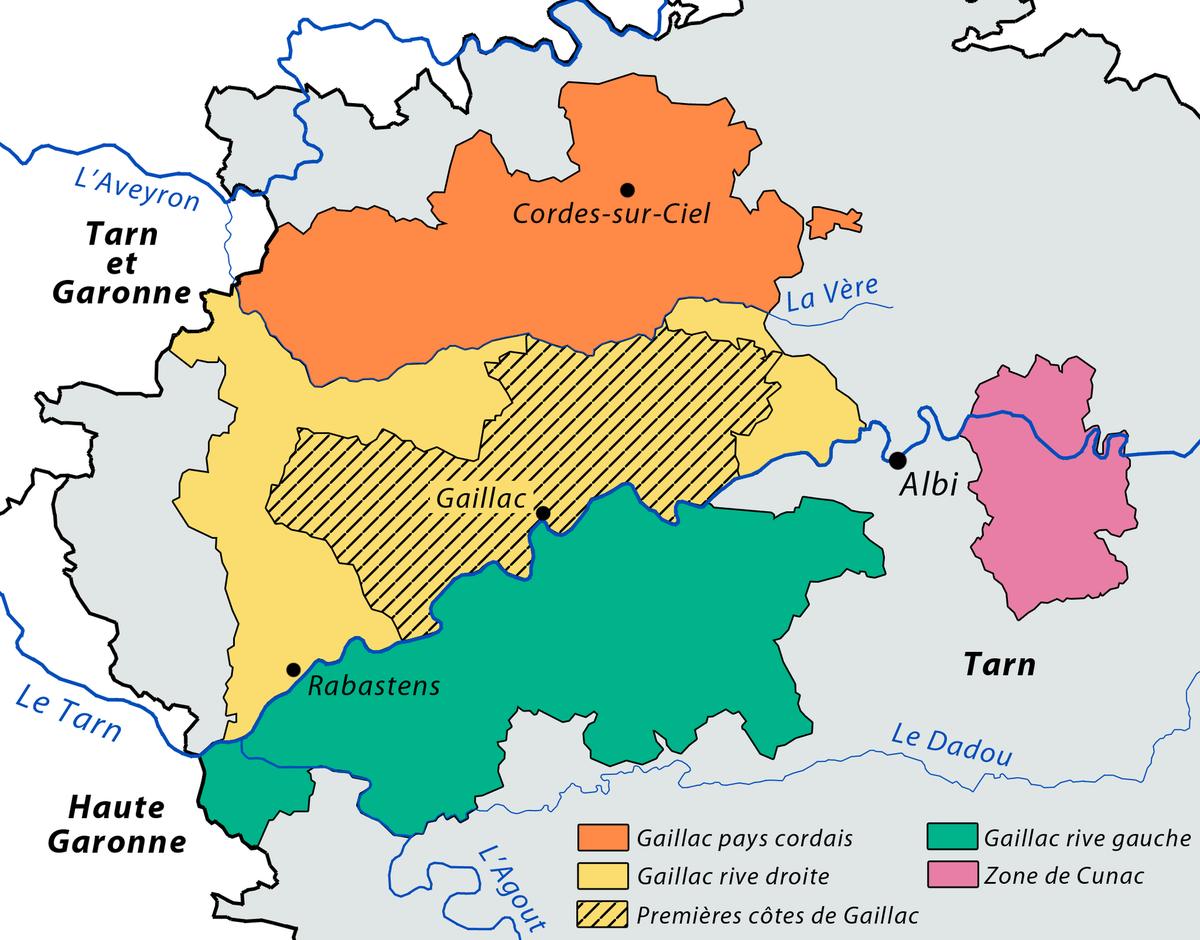
The return drive to Carcassonne is an hour and a quarter of straight road if you take the D999 south. Do not take it. Instead, leave Albi heading west on the D988 toward Gaillac, which sits 25 km away on the Tarn. Gaillac received its AOC designation in 1970, but the vineyards here claim to be among the oldest in France, with a history that predates the Roman occupation. What matters for your afternoon is that Gaillac produces reds from the Braucol grape (also called Fer Servadou) and whites from Loin de l'Œil, both of which you will struggle to find outside the region. The area under vine sits at roughly 3,000 hectares, and the domaines here are small, family-run, and unpretentious. You are not looking at château tourism with polished tasting rooms and €25 entry fees. You are looking at a farmer in a gravel courtyard who will pour you a glass of a wine that exists nowhere else.
How To Taste Without Derailing The Day
Pick one domaine with a tasting room and call ahead. The Gaillac wine region has dozens of producers, but not all of them accept walk-ins. A 15-minute tasting and a purchase of two bottles will break the drive by an hour and give you something to drink with dinner. Do not attempt three domaines. You want a single stop that paces you back toward Carcassonne without turning the drive into a second excursion.
Cordes-sur-Ciel: The Optional Detour
If you have more time, add a 10-minute detour north to Cordes-sur-Ciel. The village was founded in 1222 and sits at 485 meters above sea level, visible from the valley floor as a cluster of gray stone roofs against the sky. The climb from the car park to the top is steep and the streets are narrow, so skip it if anyone in your group has mobility limits. But the view from the top looks back across the Gaillac vineyards you just drove through, and it closes the day with a landscape that connects the wine to the hill it grew on.
More on Albi
Common Questions
Is Albi a realistic day trip from Carcassonne?
Yes, for independent drivers. The drive is 1 hour 15 minutes each way. Depart by 08:30, visit the cathedral and museum, eat lunch in Albi, and return via Gaillac. Total drive time is about 3 hours. It works best for a single day.
What should I skip in Albi if I only have one day?
Skip the guided cathedral tour. The interior is self-explanatory, and the audio guide slows you down. Skip the Musée de la Mode, which is a separate museum in Albi with no connection to the Episcopal City. Focus on Sainte-Cécile and the Toulouse-Lautrec museum.
Can I visit Albi without a car?
A train from Carcassonne to Albi requires a change in Toulouse and takes at least 2.5 hours each way. That kills the day. Public transport is skeletal in rural Languedoc. A rental car is non-negotiable for this itinerary. Book an automatic weeks in advance.
When should I avoid Albi?
Avoid August afternoons. The cathedral interior is not air-conditioned, and the heat amplifies the crowds. Visit in May, June, or September instead. If you must go in summer, arrive at 09:00 and finish by 13:00. Most shops close 14:00 to 16:00 anyway.
Read next
-
 French Wine Regions and How a Trip Through Them Actually Works
How to plan a multi-region French wine trip that connects the dots between vineyards without spending every day driving, with Languedoc as the value-driven heart.
French Wine Regions and How a Trip Through Them Actually Works
How to plan a multi-region French wine trip that connects the dots between vineyards without spending every day driving, with Languedoc as the value-driven heart.
-
 Gaillac and Its Grapes in One of the Oldest Vineyards in France
Gaillac, one of France's oldest vineyards near Albi, is defined by indigenous grapes Braucol and Loin de l'Oeil and a winemaking history that predates the Romans.
Gaillac and Its Grapes in One of the Oldest Vineyards in France
Gaillac, one of France's oldest vineyards near Albi, is defined by indigenous grapes Braucol and Loin de l'Oeil and a winemaking history that predates the Romans.