A Wine Route Through Corbières and Fitou From Narbonne to the Border
Corbières and Fitou form a rugged wine landscape between Narbonne and the Spanish border, where Cathar castle ruins rise above sun-baked vineyards and domaines welcome walk-in visitors.

.jpg)
The Corbières and Fitou Wine Route: What Most Visitors Get Wrong
The common mistake is thinking Corbières and Fitou are two similar red wine zones you can knock out in a single afternoon on a straight shot south from Narbonne. They are not. Corbières sprawls across 13,500 hectares divided into 11 distinct sub zones, from the limestone scrub of Fontfroide to the scree slopes of Quéribus. Fitou is one quarter the size at roughly 2,600 hectares, split into two separate blocks that do not touch each other. Fitou earned Languedoc's first AOC in 1948, a full 37 years before Corbières got the same status in 1985, because its shoreline vineyards faced different growing conditions than anything inland. You need a full day to drive the proper loop, and you need to understand which domaines let you walk in without notice and which require a booked appointment.
Why Fitou Was First and How it Stays Different
Fitou Maritime: Wind, Salt and Schist
Fitou got its AOC in 1948 because the French authorities recognised that the shoreline strip between Leucate and La Palme produced wine unlike anything else in the region. The Fitou Maritime block covers about nine communes including Fitou itself, Leucate, Caves and Treilles, where vines grow on schist and limestone within sight of the 7,600 hectare Étang de Leucate. The Tramontane wind blasts these seaside vineyards at 60 to 100 km/h on a normal day, gusting up to 180 km/h, which keeps disease low and concentrates the grapes. Haut Fitou sits inland around Tuchan, Paziols and Cascastel, another nine communes planted on higher, cooler terraces. The wines are fuller there, less saline. Every bottle labelled Fitou comes from one block or the other, never a blend of both.
Corbières: A Patchwork of Eleven Zones
Corbières by contrast is a patchwork. Its 11 sub zones include Boutenac, which earned its own AOC Corbières Boutenac in 2005, Fontfroide, Lagrasse, the Montagne d'Alaric and Termenès. A Corbières red from the Sigean zone near the water tastes lighter and earthier than one from the steeper slopes of Quéribus. You cannot assume a generic Corbières bottle represents the whole appellation. The common failure case: buying a case of Corbières at a supermarket in Narbonne assuming it tastes like what you drank at a domaine in Durban. It almost certainly does not.
The 150 Kilometre Loop Drive from Narbonne: Domaines, Castle Views and Lunch Timing
Start at Fontfroide, Then Head to Aguilar
Start from Narbonne and drive 15 kilometres southwest to Abbaye de Fontfroide, founded in 1093. The abbey's own 40 hectare estate produces wine you can taste on site, but book ahead. Fontfroide is a major tourist stop and walk ins are turned away during July and August. From Fontfroide continue to Durban Corbières, about 20 minutes east. Durban sits below the ruined Château d'Aguilar, one of the Cathar castles in the Corbières zone alongside Quéribus, Peyrepertuse, Termes, Villerouge Termenès and Durfort. Park at the village and walk up to Aguilar in 15 minutes, no ticket required. The view south toward the Pyrenees is the reason to stop.
Inland Tasting Culture: Knock and Taste
From Durban head southeast toward Tuchan, the village that opens the door to Haut Fitou. Tuchan is one of the villages where you can base yourself within walking distance of multiple domaines, a practical workaround for the French legal blood alcohol limit of 0.5 g/L, which translates to roughly two standard units of wine for an average adult. Domaines in Tuchan and the neighbouring villages of Cascastel and Villeneuve les Corbières operate a walk in culture. You arrive, you knock, you taste. The Fitou Maritime domaines around Leucate and Fitou village are appointment only, especially during harvest from mid August to October. Do not show up unannounced at a shorefront producer in September and expect a tasting.
The Coastal Run and Lunch
Continue from Tuchan southeast to the water at Fitou village. The Château de Fitou ruin sits above the village but is not open to the public. The practical viewpoint is the road as it drops toward the plain; pull over at one of the gravel shoulders for a photograph. From Fitou drive north along the D600 to Leucate, which sits on the spit between the Étang and the Mediterranean. This is your lunch stop. Aim to arrive at a harbour side oyster shack by 12:00. The inland village restaurants close by 14:00, and the ones on the water fill fast. Order Huîtres de Bouzigues with a glass of Picpoul de Pinet, not Fitou, because the local Picpoul cuts the brine better. The loop back to Narbonne via the D600 and A9 takes about 45 minutes. Total distance is approximately 150 kilometres. Driving time without stops is three and a half hours. With three tastings, a castle walk and a lunch, plan for six hours.
| Feature | Corbières | Fitou |
|---|---|---|
| AOC recognition year | 1985 | 1948 |
| Total planted area | Approx. 13,500 ha | Approx. 2,600 ha |
| Sub zones | 11 (Boutenac, Durban, Fontfroide, Lagrasse, Lézignan, Montagne d'Alaric, Quéribus, Saint-Victor, Serviès, Sigean, Termenès) | 2 (Fitou Maritime, coastal; Haut Fitou, inland) |
| Tasting culture | Walk ins common inland, appointment best at major sites like Fontfroide | Appointment only for most shoreline domaines; walk ins possible in Haut Fitou villages |
| Signature backdrop | Cathar castles: Quéribus, Peyrepertuse, Aguilar, Termes, Villerouge-Termenès, Durfort | Étang de Leucate and shoreline salt flats; Château de Fitou (view only, closed to public) |
| Best lunch stop timing | Aim for 12:00 at any restaurant; most close by 14:00 | Same rule: 12:00 arrival at Leucate harbour shacks for Huîtres de Bouzigues |


What Goes Wrong and How to Avoid it
The single thing that most often goes wrong on this route is the heat. July and August temperatures hit 35°C, and the Corbières hills offer no shade. Drive with air conditioning on and carry at least 1.5 litres of water per person. The second mistake is a late lunch. Inland village restaurants stop serving by 14:00, and the ones on the shore fill by 12:30. Arrive at a domaine at 13:00 expecting to eat after the tasting, and every kitchen will be closed. The third failure is relying on mobile maps. 4G coverage drops to zero in the deep gorges around the Cathar castle car parks. Download offline maps of the Aude and Pyrénées Orientales before you leave Narbonne. Download them in the morning, not at the car park.
The One Thing to Do Next
Open Google Maps or Maps.Me and download the offline map for the area between Narbonne, Leucate and Tuchan. Do it now, while you have a signal. That one download is what saves the day when the road to Tuchan loses coverage and the gravel turn off to a domaine is unmarked.
Read next
-
 Abbaye de Fontfroide
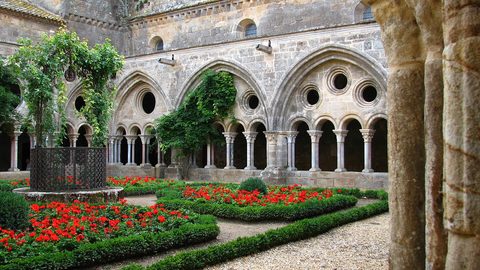
Fontfroide Abbey combines a Cistercian cloister and rose garden with its own Corbières wine domaine, 20 minutes from Narbonne, with tastings booked in advance.
Abbaye de Fontfroide
Fontfroide Abbey combines a Cistercian cloister and rose garden with its own Corbières wine domaine, 20 minutes from Narbonne, with tastings booked in advance.
-
 French Wine Regions and How a Trip Through Them Actually Works
How to plan a multi-region French wine trip that connects the dots between vineyards without spending every day driving, with Languedoc as the value-driven heart.
French Wine Regions and How a Trip Through Them Actually Works
How to plan a multi-region French wine trip that connects the dots between vineyards without spending every day driving, with Languedoc as the value-driven heart.